

Pool robots are now more common, but there are many things you need to know before you splash the cash.
UPDATE: January 2026
I apologise for being blunt here – diplomacy can mean we review robots that later turn out to be three-legged dogs. So I wanted to tell readers what I really think of the tsunami of cordless poolbots I am currently drowning in. Forgetting multiple listings, there are over 300 on Amazon AU alone and 800+ on eBay, of which 767 are generic.
Cordless poolbots are the next big thing. They are also the next consumer minefield as:
- Consumers have little knowledge of what a poolbot does, let alone the different technologies they use. This guide is constantly updated it as new technology occurs.
- There is no established longevity. Cordless poolbots from reputable brands that we reviewed three years ago are dead in the water (excuse the pun). Was the tech too rushed, not ready, and waterproofing for saltwater and harsh conditions inadequate?
- The market is awash (another pun) with cheap generic Chinese poolbots white labeled for major pool supply chains
- There are few established leaders, and old-school corded brands don’t necessarily reflect the performance, quality or longevity of new cordless poolbots. I have seen horror reviews from brands including Zodiac, Dolphin, Aiper, Polaris, Beatbot, Wybot, Kogan (an especially cheap generic Chinese white label), Airrobo/Yechnix/Hydro, iGarden and too many to mention by name. There is no guarantee of quality online.
- Warranties are so loose. Some warrant waterproofing (many do not), most warrant the electronics, few warrant the battery, and almost none warrant the rubber rotating brushes or caterpillar tracks.
So while I quite like Aiper, Wybot and now Dreame as brands of robot vacuum, I lack the important benchmarks that allow me to compare and tell you the safe buys. Caveat emptor.
Common sense rules in this emerging market. Look for:
- An established brand
- With established support and service in Australia
- Look for the longest warranty with the fewest exclusions
- Buy from a reputable pool shop as they are responsible for upholding the warranty.
- Do not buy overseas models without an RNZ C-Tick or that come with a different electrical plug.
- Let us know if you have any good or bad experiences.
UPDATE: December 2025
Based on frequent reader reports of major delivery, service and support issues, we are no longer able to recommend Robot My Life products. This includes Poolbot, Ultenic, Hobot, Moebot and other products.
CyberShack has now reviewed several pool robots and a new category of pool skimmer robots. Although the terms robot and intelligence don’t really apply as they do to robot vacuum/mops. More on that later.
We will limit this guide to cordless, rechargeable underwater vacuum cleaners that do not use the pool filter system for motion. These use power wheels, impeller suction and rotating brushes to clean the pool floor; some may clean walls, ledges, and stairs to varying degrees. We don’t cover corded robots as this implies you have a power point near the pool.
Images are from Aiper or Wybot. We update text regularly as we encounter new features and devices. Images illustrate features and do not imply endorsement.
What should a pool robot do?
This is an obvious question and answer. Charge it, chuck it in the pool, and clean your pool floor, and optionally walls and tile-lines of all debris in one charge. But as our readers have pointed out, that statement has many holes.
What is clean? Well, most pool robots only clean down to around 180-200 nm (nanometres where human and pet hair is about 50-70). Most will not vacuum up 100-150mm larger leaves and twigs because the vacuum slot is too small. Most have issues with irregularly shaped pools, stairs, ledges, and particularly rounded bottom-to-wall edges. No sales brochure tells you that.
The guide identifies those that will cure such issues, albeit at a higher cost.
Pool types
Most manufacturers claim they work on cement, tiles, pebblecrete, and vinyl pool surfaces, regardless of the shape or in-ground or above-ground construction style.
Readers have complained that some robots do not handle tight radius curved floor edges (called filets).

Some refuse to handle kidney or irregular shapes, and some get stuck on stairs. Wall-cleaning robots and above-ground pools don’t play well.
All we can recommend is that you make it a condition of sale written on the invoice that you can return it for a full refund within 7-14 days should it not work on your pool.
Consumer Advice: If the robot supplier is hesitant to allow returns, show them pictures of the pool and request that these be witnessed as evidence that they were aware of the pool. If they are unwilling, walk away.
This also applies to online orders – you don’t want to be stuck with a robot generally fit for purpose, only not in your pool.
Pool preparation – yes, you still have to do some
No matter how tempting it is to chuck and go, a few minutes with a pool leaf net and brush makes a lot of difference. Remove debris larger than 100mm, brush the stairs and ledges, and let it settle for 30 minutes. Many pool robots can climb walls to clean the walls and tile line.
Charge Time and charging place
Most robots have a 5000-10,000 mAh (5 to 10A) battery—the larger, the better, as it gives longer run time. Some have 12 to 14V batteries with higher amps that simply don’t have the staying power. Look for 20-25V or higher batteries with lower amps.
As a guide, Volts x Amps = Watts, which is a good indication of capacity. A 14V/8A/112W won’t last nearly as long as a 25V/8A/200W battery, yet both have 8,000mA batteries.
Manufacturers claim fast charging, but it usually takes at least 3-5 hours on all tested so far. These must be charged in the shade and away from the pool, so they end up living in the garage. Make sure you have a dry ‘home’ for the robot.
Precaution: Charging a wet robot is not a good idea. Ensure the charge points are dry and use an HPM Electresafe Power Centre with two USB outlets REPC410USB with an RCBO (Residual Current Breaker with Overload) to prevent electrical shock. This should be in every Aussie garage.

Some now have charging cradles that you place the robot on. Technically, these are better as they have waterproof +/- charge plates, but that should not be the primary influencer for purchase.

Consumer Advice: These generally have over 100W lithium-ion batteries, which exceeds the limit for inside home charging. Charging must be out of direct sunlight and on non-flammable materials like tiles or a driveway. Do not store flammable materials within 3m of the robot. Read Is there a safe way to charge Lithium-ion batteries?
Speed – not as important as doing a good job
There is often a marketing focus on speed, which is not as important as doing a good job; if a robot must clean twice to get everything done, so be it.
It should be able to cover 10 linear metres per minute, and you relate that to battery runtime. However, coverage per charge is more important than speed, and as you will see later, litres per minute suction is more important.
Robot wheels – caterpillar is best
While many have silicon or rubberised ribbed caterpillar tracks, some still use rubber-ribbed wheels. Some review samples have seen significant wear in just a few months.

Remember that these work in a hostile environment (chlorine or salt) on an abrasive surface (concrete or grout) and are the first to wear out. Warranty does not generally cover these, and it is vital to ensure that they are available for at least five years, so buy a couple of spare sets.
They should be replaceable without dismantling the whole robot or affecting waterproofing.
Front and hopefully rear scrubbers
Most have front, round, rotating scrubber pads. These can wear faster than the wheels, so the same advice applies.
However, we have discovered that some pads will counter-rotate (dual active), which helps navigation in corners, and some have front and rear roller scrubbers. These do a superior job.

Intelligent and Dumb pool robots
2025 saw the first of the intelligent poolbots. Aiper’s Scuba X1 Pro and its combo poolbot and skimmer X1 Pro Max can create a map and have spatial awareness. They work similarly to a LiDAR robovac. These have massive numbers of sensors (26 and 50 and 4, and 9 motors respectively).
But remember, GPS or Wi-Fi location does not work underwater, and you may need to invest in a floating communications device.
Do they work? Yes, these work well on irregularly shaped pools and tight curvature fillets. Provided there is enough water over ledges and stairs, they will clean them too.
But most poolbots are dumb, using programmed responses to minimal criteria. If it cannot move forward, it turns right or left until it can. Some will also try to reverse out of corners.
Some have rudimentary IR proximity and accelerometer/gyro sensors; the more, the better. Aiper’s 2025 Scuba X1 is one of these and works really well in standard-shaped pools, although it has 14 sensors and four motors, so we can hardly call it dumb.
So be sceptical about those that advertise an app, a map and intelligence. Apart from Aiper Scuba X1 Pro and X1 Pro Max, at best, these allow you to update firmware and set cleaning patterns.
Cleaning patterns
Dumb robots do not know where they are. The robot will start to clean the floor (assuming it is set to do so) and bump its way around until it finds a corner (approx. 90°) and follows a wall (usually for up to 5 metres or until it bumps into another corner. It is then a rinse-and-repeat replication of one of several pre-programmed cleaning patterns.
Many readers complain that their robots (all brands) seem to vacuum the same spots, and they are right. Our observation is that if a pre-set pattern is disturbed, the robot will aimlessly wander around until it reestablishes a pattern or the battery expires. The cure – restart it.
Floor patterns include:
- Short or long side ‘U’ where it turns around at a wall and moves slightly over to do the next run
- Replicated short and long sides – a double pass or crisscross.
- Star pattern for irregularly shaped pools, where it finds what it thinks is the centre and cleans in a star pattern until it hits a wall.
Wall patterns include:
- Up-down with or without waterline tile cleaning (sometimes called H pattern)
- V-shape up, turnaround and descend to one side (sometimes called N pattern)
- Waterline only
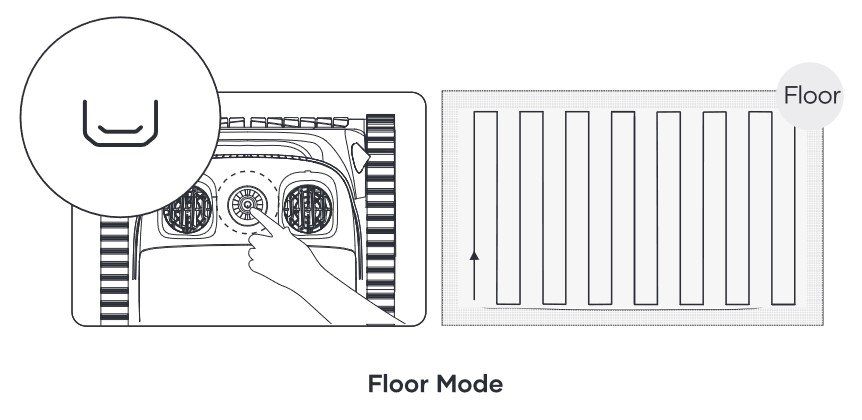
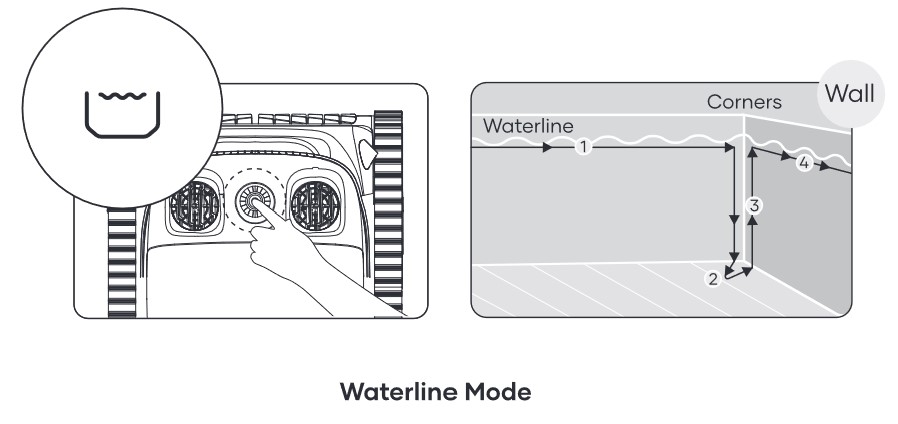
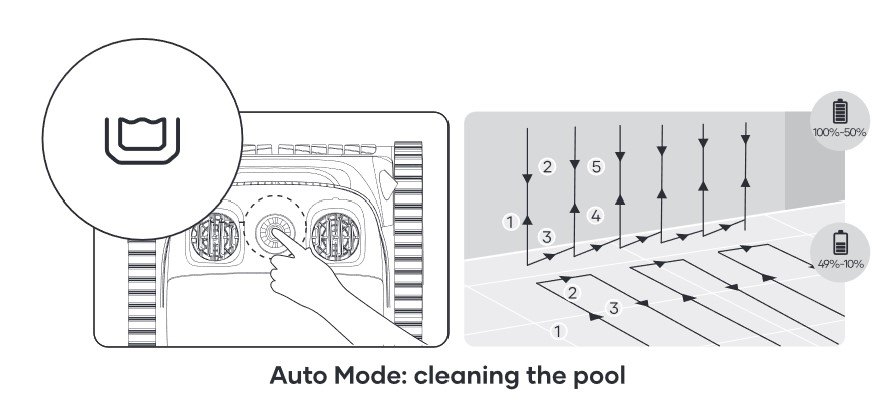

Some have an Eco mode that allows you to leave the robot in the pool for a week and have its floor cleaned every two days, so you always have a clean pool—I like that.
Steps, loveseats, and ledges – Probably not
The robot must remain completely submerged to work, so if it’s larger than the steps, loveseats, or ledges, it will not clean them.
Currently, no robot allows you to set no-go zones (because they don’t have a map) like their land-based cousins.
Also, be aware that pool lights and other protrusions may affect the robot’s ability to climb walls.

Maintenance – a must
While they should be at least IP68 and can withstand a few hours of dunking in chlorine or salt water, they need to be removed, washed in clean tap water, dried, recharged (sensibly – these are lithium-ion powered) and protected from the weather, preferably in a garage. A spray of WD-40 (water displacement) on the electrical contacts will prevent oxidation.
Some readers have commented that the robots left around the pool area deteriorate pretty quickly.
Filter baskets
As mentioned, most filter to 150-200 μm (some are 300 μm), which means they do not pick up pet or human hair, let alone algae and silt.
Some (Aiper X1 series) have 3 μm secondary filters, which are needed for dirty pools. This also means that the pool filter (usually effective from 10-40 μm) does not get clogged, as the robot filters the fines out.
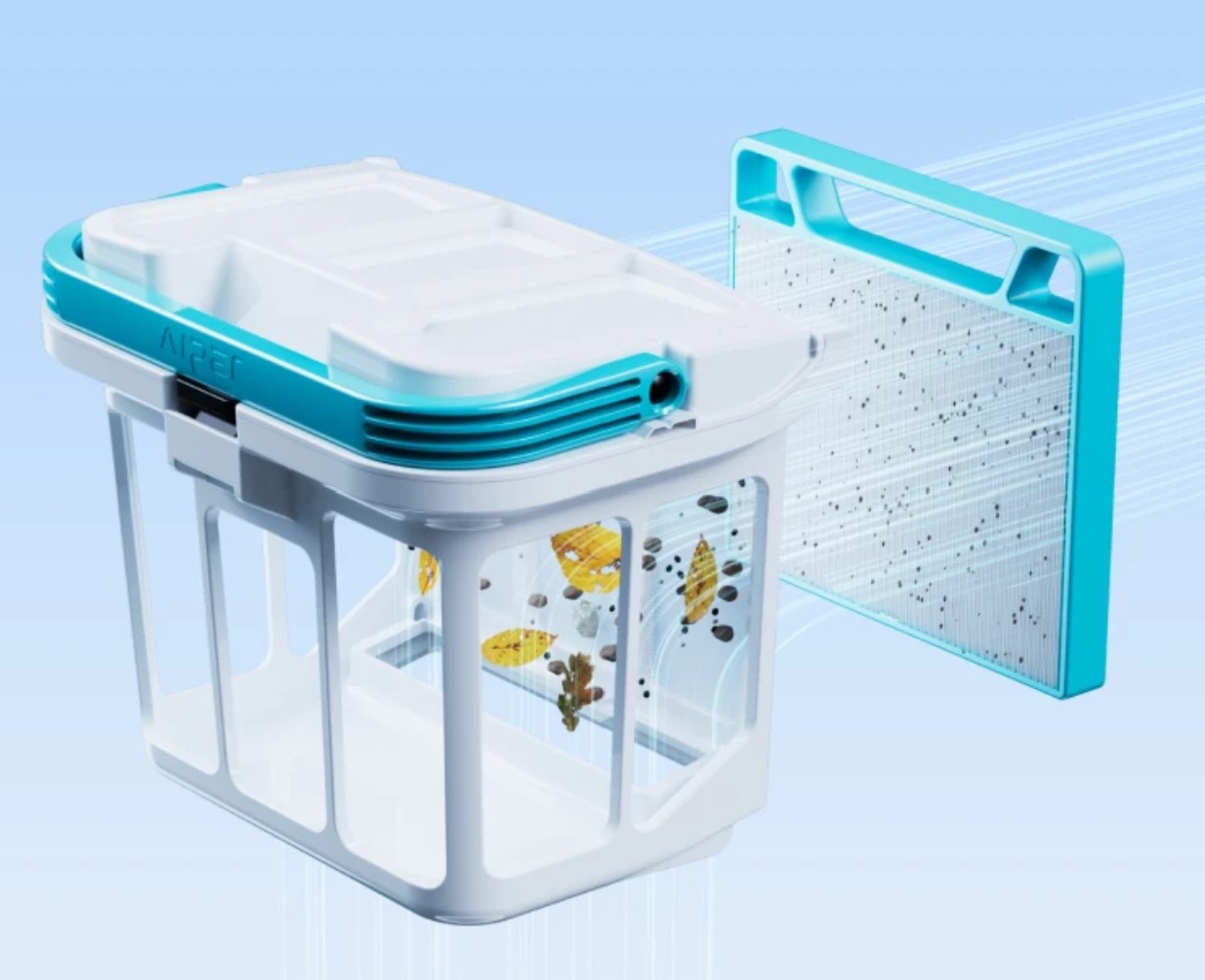
The capacity must be sufficient for the pool size: a small pool should be around 2L, and larger pools should be at least 5L.
Readers have tried filter basket ‘socks’, but these are only around 100 μm and can interfere with the robot’s suction.
We have mentioned regularly replacing caterpillar tracks and scrubbers, but the filter baskets need equal attention. They should be hosed out and dried before reinserting.
We have found that filter baskets with a lid are more effective at keeping the detritus in.
Number of engines/pumps
Cheaper robots will have one drive engine for the wheels, front brush and suction impeller. These are easy to spot by lower litres per minute (LPM) suction, often 100-200.
The higher the LPM (or, in the US, GPM—gallons per minute, where a gallon equals 4.5 litres), the better, so look for around 250 or higher.
Three engines are minimum—at least one for the wheels, one for the rotating brush, and one for the vacuum impeller. Aiper X1 and X12 Pro have four motors, and the X1 Pro Max has nine.
Some have additional engines for propulsion and rotating wheels. They use more battery, but it can be the solution for complex pool shapes.
How long will it last?
Realistically, five years is all you can expect, even from a premium robot. If parts are available, you can extend that.
It should go without saying that these devices are expensive and deserve a decent warranty, as well as helpful, prompt after-sales service when needed. We expect at least a 2-year Australian Consumer Law warranty.
Read the fine print as well. The warranty is generally two years on the motor and PCB and one year on the battery pack. Wear-and-tear items such as caterpillar tracks, filters, or roller brushes are consumables. This is pretty standard for any robot.
Most warranties only apply to the company’s online sales and approved resellers – not to grey market imports.
After-sales service – vital
Some readers’ experiences, especially when buying online, are less than stellar, with some resorting to Fair Trading to get remedies. We no longer cover that brand and have updated these reviews.
We only test for four weeks, so we strongly recommend that you look closely at Australian trust review sites like Trust Pilot and look for the Australian company (not the US, EU or Chinese parent).
However, look only at recent 2025 reviews, as technology has changed a lot, and earlier models may have been less than reliable. Also, be careful where there are similar amounts of 1—and 5-star reviews—it is too easy to flood these sites with fake reviews.
If a reader has a good or bad experience, please let us know.
Cleaning ratings – a hard one
Because every pool is different in shape, size, curvature of the bottom walls/floor, etc., we can only make a subjective assessment.
- ‘A’ will mean as good as you do with a manual vacuum. No missed spots, with good corner and edge clean.
- ‘B’ means at least 90% of detritus is collected. Acceptable corner and edge clean.
- ‘C’ means at least 80% of detritus collected with obvious edge and corner issues.
- ‘D’ means 70% cleaning with patches of missed detritus and significant edge and corner issues.
- Fail. Due to their speed, some robots create a ‘bow’ wave that blows the detritus out of the vacuum path. No matter how many times they vacuum the pool, there is still detritus.
Robot pool skimmers
We have tested four robot pool skimmers, and these follow similar design cues. As we test more skimmers, we will add more information. Two have solar panels for all-day use.
Our best advice is to look for a ‘paddle-wheel’ style that helps suck in the floating detritus. The weir style often suffers from ‘backwash regurgitation’, spitting out its contents when turning.
We are extremely pleased with the Aiper Surfer S1 and the 2025 Suirfer S2.
CyberShack’s view: Pool Robots deserve a second look because they are terrific when they work for you
After we write a guide, we read other guides to see if we got it largely right or wrong. Not surprisingly, there were few independent guides (Choice has a basic guide), and pool shops or robot manufacturers wrote the majority. Unbiased – not. Because 99% are biased, there was a lot of subtle ‘sledging’ of other brands.
We are not claiming that this guide – version 1 – is definitive, but all guides start after we have sufficient experience to feel qualified to write one. So far, we have reviewed Robot My Life, Aiper, BeatBot, iGarden (not approved for use here) and Wybot (just starting).
Our pool robots experience is with:
- Aiper Surfer 2025 S2 – skims the pool to keep the filter clean
- Aiper Scuba 2025 X1: The essential poolbot with heaps of benefits
- Aiper Scuba 2025 X1 Pro: adds smarts to the essential poolbot
- Aiper 2035 Scuba X1 Pro Max – what doesn’t it do?
- Aiper Scuba 2024 S1 pool robot – no-fuss, no app, just simple cleaning (mid-range for smaller pools – no app)
- Aiper Scuba 2024 S1 Pro – a pool robot with a 3um ultra-fine algae/silt filter (premium for larger pools with Wi-Fi app)
- Aiper Surfer S024 S1 robot pool skimmer – eats leaves and floating rubbish (this is a robot skimmer, and it gives excellent results)
- Beatbot 2024 Aquasense Pro robot pool cleaner – floor, walls, and surface skimming in one
- Beatbot 2024 iSkim Ultra pool robot skimmer – gets it all
- Our long-term test of a Wybot pool cleaner
- We have rejected several popular brands based on readers’ experiences.
Our best advice is to go to one of the larger pool shops to start your education and then look for 100% independent reviews (as we provide).







Comments