
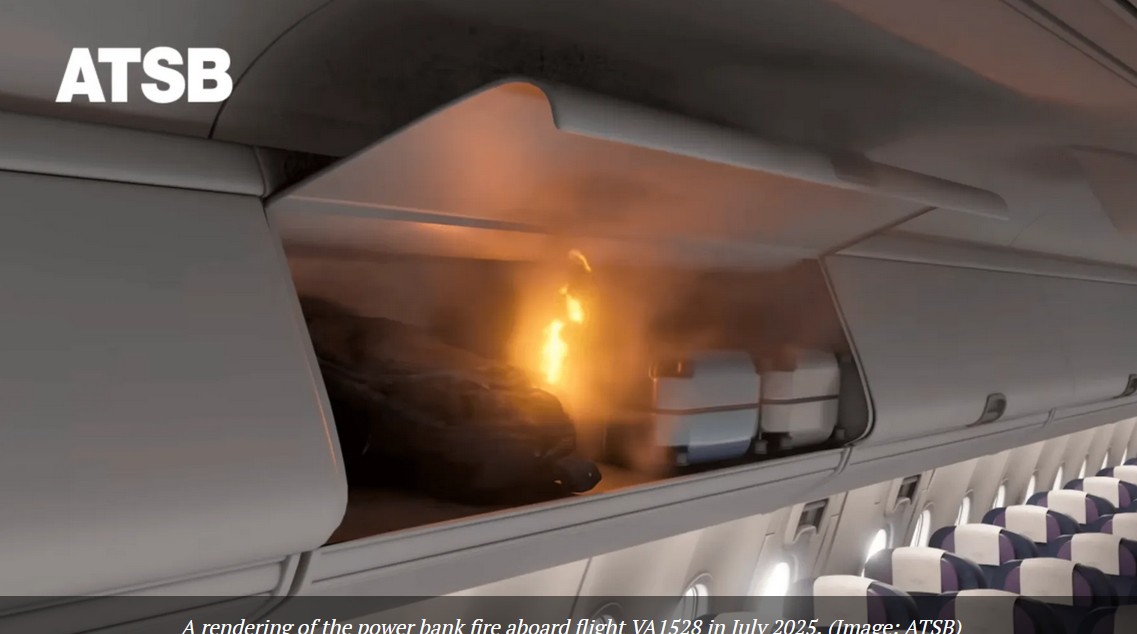
Virgins final battery bank policy has important new rules that could see your battery bank confiscated prior to boarding unless you pay close attention.
Virgin’s final battery bank policy is here, but we wanted to reinforce some of the new conditions solely for portable battery banks (for other battery types, please read the policy).
Battery bank capacity
- Up to 100Wh is permitted on board (typically up to 27,000mAh)
- 101-160Wh must be declared at check-in.
- >160Wh banned
- No battery may be in checked luggage.
Portable electronic devices like laptops have an internal battery. Up to 100Wh is permitted. Take care that some newer laptops and MacBooks may have larger batteries and may not be allowed without approval.
How to calculate Wh (Watt hours)
Use Ohm’s law. Volts x Amps = Watts.
Battery banks typically use approx. 3.7V cells. If you know either the mAh (milliamp hours – to get Amps divide by 1000) or Wh, you can work it out. For example:
- 100Wh: 3.7V x ??A = 100Wh is 100/3.7=27A (or 27000 mAh)
- 27000 mAh: 3.7 x 2.7 (divide by 1000) = ??Wh is 3.7 x 27 = 100Wh
The capacity has nothing to do with the charger PD/PPS outputs or maximum charge output.
If you can’t find the capacity on the battery bank, then it will likely be banned (see packaging below)
Here are some standard battery and power bank specifications to assist you:
| mAh | A | Voltage (V) | W/Wh | Ready to Travel? |
| 5,000 | 5 | 3.7 | 18.5 | Yes |
| 10,000 | 10 | 3.7 | 37 | Yes |
| 20,000 | 20 | 3.7 | 74 | Yes |
| 25,000 | 25 | 3.7 | 92.5 | Yes |
| 30,000 | 30 | 3.7 | 111 | With Virgin Australia approval, a limit of two |
| 40,000 | 40 | 5.0 | 200 | No, unless required for a mobility device |
Any Lithium chemistry battery is included
- Li-ion: lithium ion
- LiPo: lithium-ion polymer
- LCO: lithium cobalt oxide
- LiFePO4: lithium iron phosphate (while these are safer, they are included)
The battery banks must be packed correctly
- In its original retail box packaging. This helps to quickly identify the brand, model, capacity and R-NZ C-tick certification. International travellers can use the CE or FCC certification.
- If not in retail packaging, the original manufacturer’s label must be clearly visible and readable to verify the brand, model, capacity and R-NZ C-tick certification. Batteries not meeting these criteria are banned.
- If not in retail packaging, use a ziplock plastic bag, or a separate protective fire-safe pouch, and place insulating tape over any exposed terminals (more for cell batteries).
- All USB cables or charger adapters must be removed and stored separately.
- Batteries showing any signs of distress (damaged, swollen, leaking, recalled*, showing signs of defect, repaired or modified) are banned.
* Certain models from Anker, Baseus, SnapWireless, Quad Lock, Boostcharge and Cygnett are subject to recall.

When onboard
- All battery banks in the cabin must be stowed in the seat pocket, under the seat in front, or kept on you / in your hands. They cannot go in on the overhead lockers.
- You cannot use the battery bank
- You cannot charge the battery bank
Other devices
All portable electronic devices that contain batteries (like phones, laptops, tablets, earbuds, hair straighteners, toothbrushes, shavers, vapes, and medical devices), as well as battery banks, spare batteries and wireless portable chargers are subject to the same rules.
What to look for?
Despite not using or charging on board, the passenger has an obligation to check the battery bank regularly for signs of heat or swelling. Should any symptoms be observed that could result in a fire, the attendant needs to know immediately.

Planes generally have seat power outlets
As of November 2025, Virgin Australia has introduced in-seat charging ports on all seats in 88% of the Boeing 737 fleet. The remaining 12% of aircraft will be fully equipped with in-seat power by June 2026. All of Virgin Australia’s Embraer 190-E2 aircraft have already been fitted with in-seat power.
As a general guide, USB-A outputs are 5V/2A/10W, and USB-C can range from 5V/3A/15W to as high as 60W.
What happens if you pack a battery bank in checked luggage?
A pilot with Virgin Australia (not Virgin itself) has provided this information.
Checked luggage is X-rayed, and if portable battery banks are detected, the luggage will not be processed for loading. Australian baggage handlers are not approved to open baggage and remove the portable battery bank.
Airport Security (not the airline) will attempt to contact the customer in the terminal and request personal removal. Failure to do so will result in the person being denied boarding until the item is removed. They cannot elect for baggage to remain at the terminal. If the battery bank is approved, it can be taken on board. If not, it is forfeit. There is no option to store the battery (or baggage) at the terminal and collect it on return.
Virgins final battery bank policy can cost you big time!
Airlines have no obligation whatsoever to refund or reschedule any passenger denied boarding due to a lack of time to remove the device.
In the USA, passengers face fines up to US$17,000 for attempting to transport unauthorised hazardous materials.
Virgins final battery bank policy, Virgins final battery bank policy, Virgins final battery bank policy, Virgins final battery bank policy,








Comments