

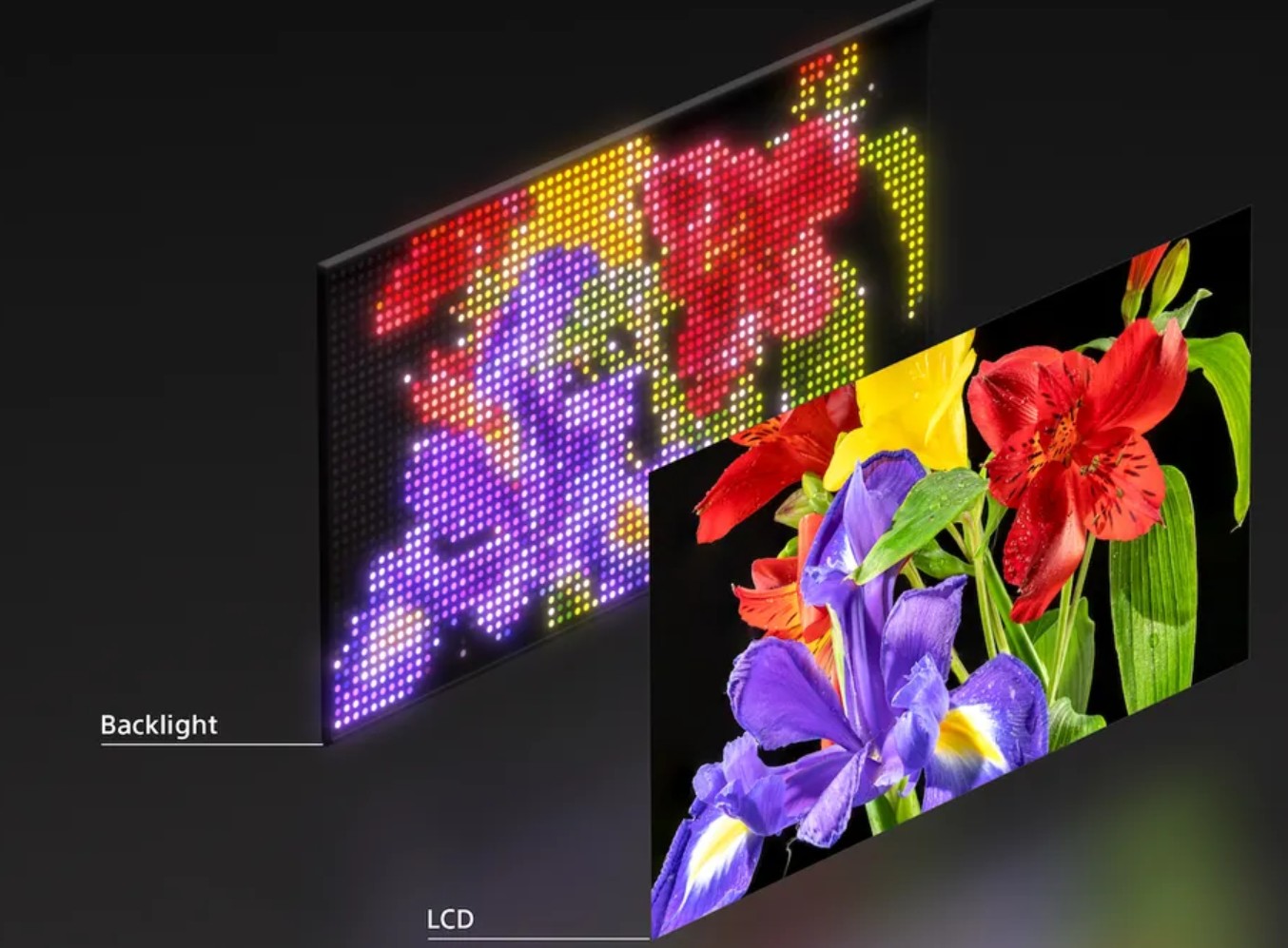
Samsung’s Micro RGB uses sub-100 μm Red, Green, and Blue combo LEDs as a backlight for an LCD panel. It is really an RGB mini LED.
It is not micro LED – a TV technology that, when commercialised, uses one RGB LED per pixel and will blow all other TV panel types out of the water.
Samsung and LG, long masters of hype, are using the term Micro RGB in the hope that it makes potential buyers think there are more LEDs than Sony, TCL and Hisense, which are correctly calling their version RGB Mini LED.
To be clear, all use three smaller red, green and blue diodes in the same physical size as a typical 100 μm Mini-LED.
This needs to be called out because there is a lot more to this hype.
The problem stems from no formal controls or standard definitions of what can be called Mini LED. Some brands use an unofficial standard of a mini LED between 100 and 200 micrometres (μm).
Samsung and LG don’t always follow this. Samsung was caught calling some TVs ‘Mini LED’ when they only used Mini LEDs as the light source. The expensive Frame Pro 2025 and the Samsung QN70F were edge-lit. Yes, the LEDs are Mini LED, but edge-lit is the lowest-performing and cheapest way to make a TV. LG pulled the same trick on some of its Mini LED models.
LED sizes (for reference)
- LED: 500-1000μm or larger (sometimes 300μm). Any TV not calling itself Mini LED
- White or Blue Mini-LED: 100-200μm. Every TV calling itself Mini LED
- RGB Mini-LED: 100-200 μm containing separate RGB diodes.
- True Micro LED: 20-50 μm self-emissive per pixel5
- OLED (Organic Light-Emitting Diode) 10-50 μm self-emissive per pixel (this is more about pixel size and density)
These sizes are approximate because they vary with TV size. All 4K TVs have 8.3 million pixels, but the pixel size can vary from 10 to 400 um as the TVS get larger.
So forget the hype – Micro LED, they are not
The nirvana is Micro LED, where each of the 4K 8.3 million pixels is an individually addressable, self-emissive pixel just like OLED already is.
Samsung and LG won’t reveal the Mini LED size or how many RGB LEDs are in their new models (top secret). All we know is that they are the same size as a typical mini LED (about 100 μm) but are a combo version with Red, Green and Blue Diodes in the same-sized package.
There are downsides and upsides to RGB Mini LED.
Downsides
- It does not remove haloing, blooming, crosstalk/smear, colour bleed, and colour distortion associated with all LCD panels.
- It uses far more power to manage more local dimming zones and colours, which can cause desyncs or glitches, sometimes requiring local dimming to be turned off for normal viewing.
- Prone to Black Crush (loss of detail in dark scenes)
- Slower response times. Fast-moving bright objects may suffer from trailing or desync issues if the backlight zones cannot turn on/off fast enough to match the pixel movement.
- Increased input lag can make them less suitable for competitive gaming.
- It is suited to VA panels, which already have far more limited viewing angles
- Higher power TV processor and more RAM are needed.
- Higher heat generation and less energy efficient.
- Reports already of early models degrading, leading to uniformity problems, such as “patchy” darks or “zebra stripes”.
- Brightness and colour degradation of 30+% over a typical panel life
- It is merely a stepping stone to micro LED
- Not as colour accurate or anywhere near the infinite contrast of OLED
- Uses PWM (pulse width modulation dimming), which can cause lots of issues (PWM – Is your phone making you sick?)
Upsides
- Eliminates the need for inefficient colour filters or even Quantum Dot colour emitters, as the LEDs produce each primary colour.
- Wider 10-bit colour gamut approaching BT.2020 (higher than DCI-P3)
- Can produce higher brightness (some can hit 5000 nits peak) due to fewer light-absorbing filters
- The more dimming zones, the higher contrast and more controlled halo or blooming
- Less blue light emission than Blue Mini LEDs
- RGB Mini LED is the successor to Blue MINI LED.
Too much marketing hype
All the hype, yet RGB Mini LED panels are currently only made by BOE Technology and TCL’s China Star Optoelectronics Technology (CSOT). Any brand RGB Mini LED will use either panel.
TV makers can control what processor they use, what screen finish (matte, reflective, Micro Lens Array MLA, which LG calls evo, etc.), warranty, and importantly how much sypware they include.
Spyware?
Yes. Please read
- Smart TVs sucking up your viewing data – and more
- They should pay you to have a smart TV
- Smart TVs data harvesting: How to reduce spying.
For that reason, we have been unable to recommend LG or Samsung TVs in 2025, as their privacy and terms of use open the floodgates to ‘rivers of gold’ monetising your viewing habits. LG even includes a non-removable Microsoft Copilot in WebOS (you cannot delete or disable it – just hide the shortcut). Samsung has ramped up Bixby and SmartThings.
While Sony (Google TV), TCL (Google TV), Hisense (VIDAA) and others also gather viewer data, users can decide what they allow to be used.

Back to marketing hype
Samsung or LG have not revealed the secret sauce of all RGB Mini LED TVs – the number of dimming zones. Micro RGB is not self-emissive and can’t be shut off individually for true black and true white – infinite contrast. It relies on local dimming zones, just like most LCD TVs.
The exact zone count, the size of the LEDs, and, more importantly, the algorithms that control them have the most significant impact on contrast and local dimming performance.
It is really RGB Mini LED – three colours instead of one in a similar-sized LED.
- Samsung expects to have 55, 65, 75, 85, 100 and 115-inch models.
- LG is calling their version MRGB95 Micro RGB evo, and it will come in 75, 86 and 100”.
- Hisense is calling its version RGB Mini-LED (but it is not a white mini-LED; it uses an RGB LED). It will have a 100 and 116” UX model.
- Sony calls it True RGB LED
- TCL Q9M and Q100M calls It RGB mini LED
CyberShack’s summary: RGB Micro LED – no. RGB Mini LED – yes
Let’s not look at Samsung’s marketing hype because, at its most elementary level, all Micro RGB does is replace white LED edge-lit, back-lit, FALD and mini-LED LCD TV backlights with RGB comba mini LEDs. It still sits under LCD TV panel technology and all the baggage that technology has.







Comments