
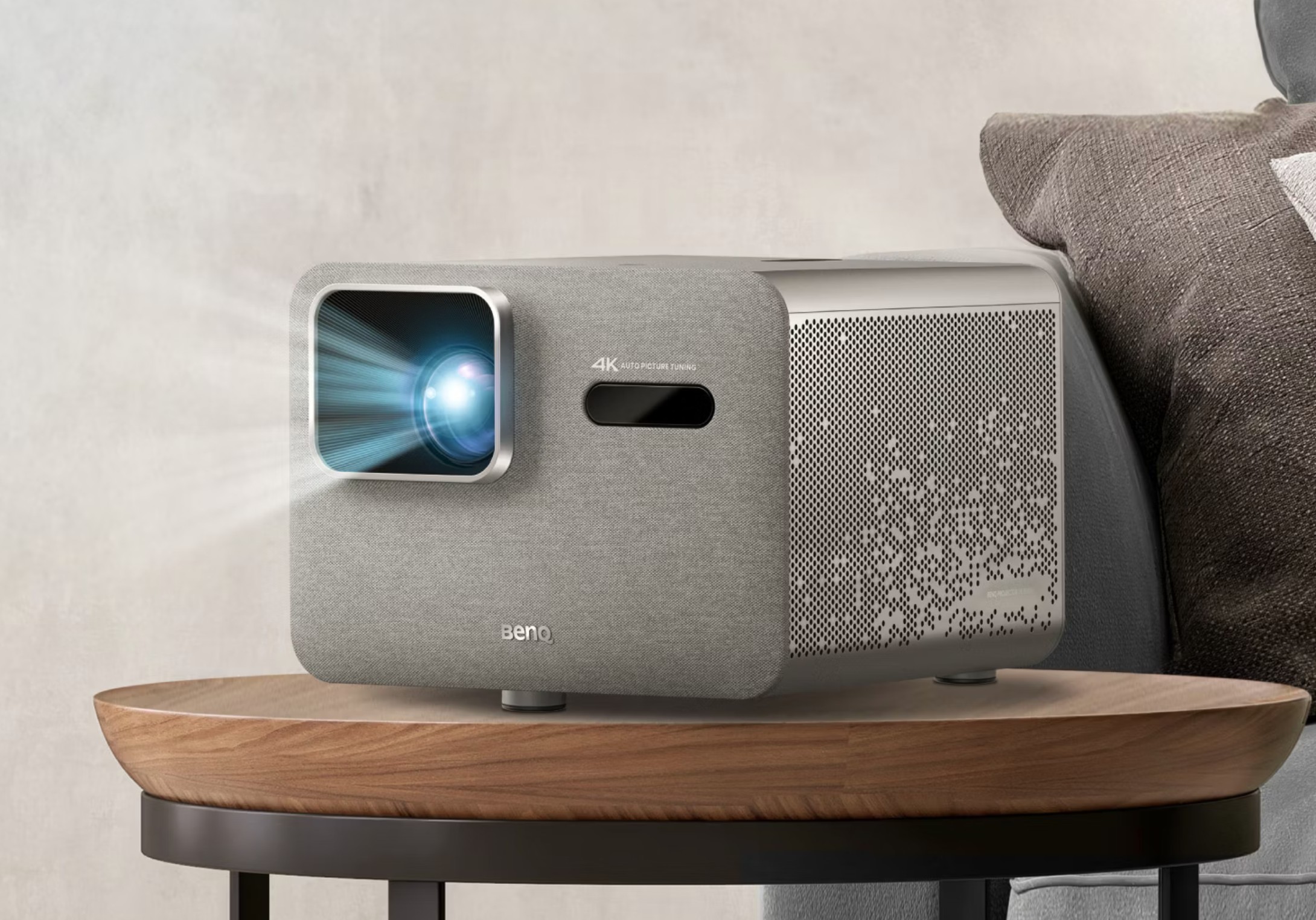
The BenQ TK705Sti 4K Short Throw Google TV projector has 3000 ANSI Lumens and 10-bit/1.07 billion colours. It may just be the home projector you have been looking for.
Before we get into the review, let me tell you of our experience with projectors – even those costing several thousand dollars more. The ‘pro’ is a huge image, and the ‘con’ is that they never begin to match the quality of a decent mini-LED or OLED TV. Videophiles can stop reading now.
Those cons also include – the more you pay, the fewer the cons (BenQ in brackets)
- You pay a lot more for Dolby Vision and Atmos (HDR10+, no DV)
- Ditto for DCI-P3 movie colour gamut (this is 98% Rec. 709, which is similar to 98% sRGB and about 65% DCI-P3)
- Sound is usually mono or stereo (2.0 downmix of up to 8 channels)
- Most are <1000 ANSI lumens (3000, which is roughly 834 nits in a dark room)
- Most require a long throw – approx 3m for 100” (1.8m for 100”)
- Many are straight projectors (Google TV 14 and Netflix/Prime licensed)
- Most don’t have a USB-C 3.2 port with ALT DP and 30W downstream power (Yes)
- Most are not true 4K but use dithering (Texas Instruments DLP chip produces 8.3m pixels from 4 x 1080p frames)
- Many use an inferior IR for keystone and focus (ToF laser)
- Most have HDMI 1.4 or 2.0 (2.1 eARC/ALL/VRR/CEC up to 8 channel sound pass-through for a soundbar)
- Most are Wi-Fi 5 if using Google TV (Wi-Fi 6)
BenQ has packed a lot into this $2,499 unit, making it a viable 4K entry-level media room projector.
There is also a very functional $129 stand.
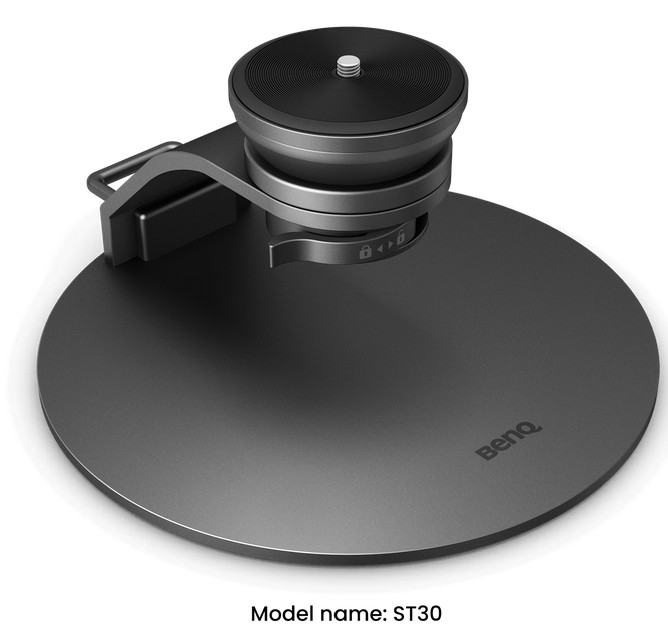
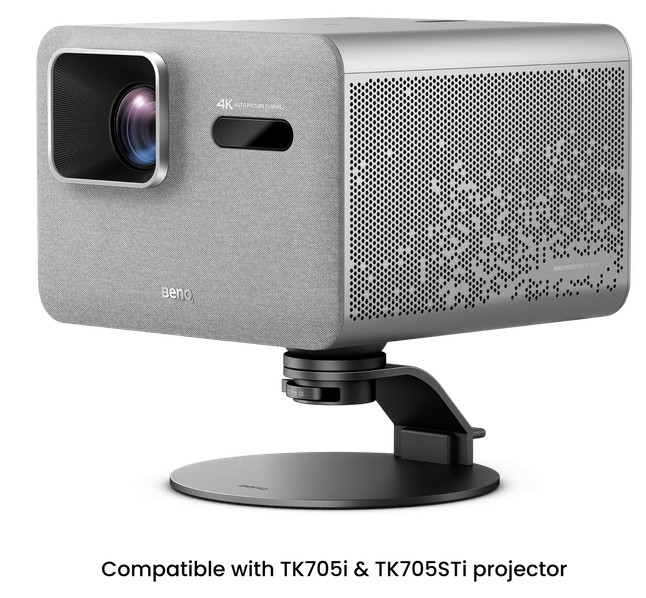
Australian revi$129 ew: BenQ TK705Sti 4K Short Throw Google TV projector (as at 30/11/25)
Note: There is a long-throw version, TK705i, if the short-throw does not suit your room size. This review relates to the STi version.
| Website | BenQ 4K range TK705STi Manual Quick Start TK705i |
| Price | $2499 TK705Sti $2199 TK705i |
| Colours | Silver |
| From | BenQ online, Officeworks, and BenQ monitor retailers |
| Warranty | 3-year ACL return to base (1-year lamp) |
| BenQ | BenQ Corporation is a Taiwan-based multinational company that sells and markets technology products, consumer electronics, computing, and communications devices under the BenQ brand name. |
| More | CyberShack protector news and reviews |
Ratings
We use the following ratings for many of the items below. CyberShack regards a score between 70 and 80/100 as a fit-for-purpose pass mark. You can click on most images to enlarge them.
- Fail (below expectations), and we will let you know if this affects its use.
- Pass(able) rating that is not as good as it should be.
- Pass (meets expectations).
- Pass ‘+’ rating to show it is good, but does not quite make it to Exceed
- Exceed (surpasses expectations or is the class leader).
First Impression – Silver, boxy
Style is increasingly important in a home, and this has a unique style. It is kind of a semi-portable at 229.2 (W) x 249.7 (D) x 168.2 (H) x 3.8 kg, but the huge power supply brick reminds you that this is meant for semi-permanent installs.
Speaking of that, you can front, side, ceiling, desk and rear ceiling or desk mount this. It has height-adjustable feet and a ‘pole’ and top and bottom ¼” tripod mounts for a perfect screen fit.
The ports are on the back, the focus and other controls on the right side.
Setup – Easy
Presuming you know Google TV, it is a simple matter of adding your Gmail account and connecting to Wi-Fi 2.4 or 5Ghz (recommended for streaming). It has the latest Google TV 14 and November 2025 security patch.
Make sure you update the Google Android TV and the Projector firmware (from the settings button), and you are away.
The projector will auto-focus and keystone correct. The Time-of-Flight sensors do a good job if they are on a horizontal surface.
Next, download and install digital TV streaming apps and anything else you like from the Google TV Play Store.
BenQ SmartRemote App – Pass
The SmartRemote app is not necessary, and in using it, you agree to BenQ’s extra terms and conditions and optionally register an account that focuses on marketing.
The physical remote is overall more useful and covers Google TV and BenQ setup.


Remote Control with Battery RCI079: Pass
It is a typical non-backlit Google TV remote with IR and Bluetooth connections. It supports voice OK Google commands. Presets support Netflix, Prime, YouTube, and Live TV (Digital channels)
Auto everything – Pass+
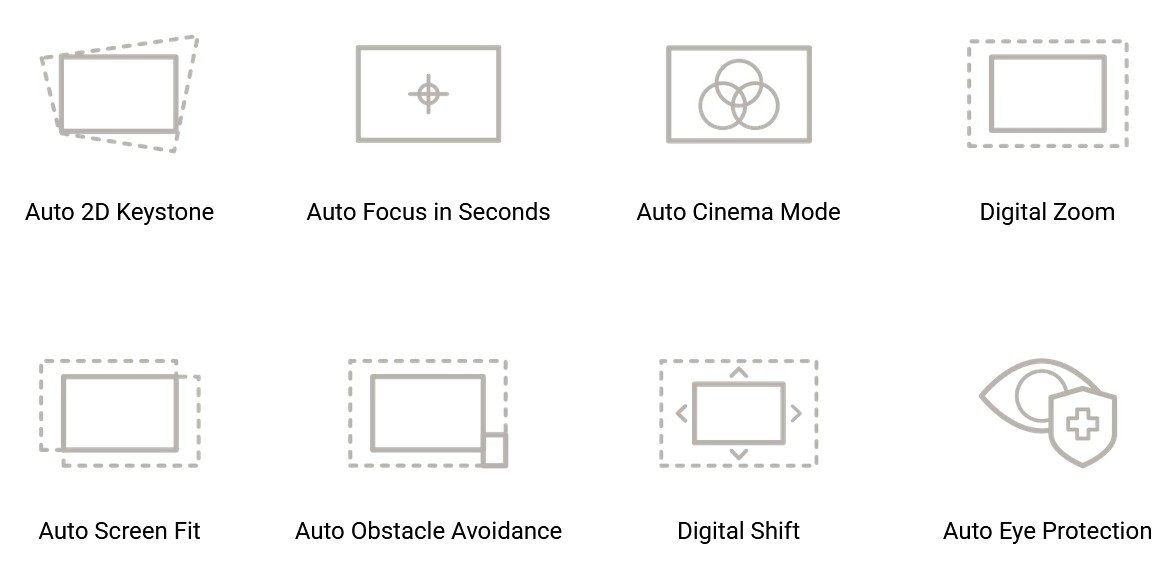
BenQ does not skimp on screen adjustment. It uses a ToF (Time of Flight) front sensor to measure the distance to the screen at all corners accurately. It can digitally correct keystone (how ‘square’ an image is) up to 30° Vertical and 20° Horizontal, focus, and screen-fit.
We tested in several mounting modes, and it is highly accurate. There was no need to correct any image manually.
Screen size: Pass+
With a .8 short throw ratio, it can project a 100” diagonal screen at 1.8m. The screen size range is 50” (.866m) to 160” (2.843m). Remember, the further the screen is away, the dimmer it gets. The ideal throw for this is up to 100”.
4K, 10-bit: Pass+
BenQ use the Texas Instruments DLP (Digital Light Processing) chip .47 (likely a Ti DLP 471 or 472). This produces the equivalent of 10-bit/1.07 billion colours through FRC (frame rate control). BenQ claims 98% of REC. 709, which is roughly equal to the 16.7m sRGB colour space. We calculate that it is about 65% of the DCI-P3 movie colour gamut.
Not to worry – that is very good for a semi-portable projector and will show more colours and tones than most competitors.
This uses a Digital Micromirror Device (DMD) with millions of microscopic mirrors to create images. These mirrors tilt rapidly to reflect light through a lens, creating pixels. LEDs separate the light into red, green, and blue sequences, which are then rapidly combined by the human eye to form a full-colour image.
The DLP chip splits the 4K UHD input frames into four 1080p sub-images and displays them serially on 2+ million mirrors. The actuator module, in tandem, steers each of the sub-images to unique positions on the screen, effectively creating 4K 8.3 million pixels.
It has a life of about 100,0000 hours. There are other technologies like 3 Chip LCD, but at this price point, DLP rules.
Unlike many of the earlier DLP chips that used spinning colour wheels to separate colours, there is no rainbow effect.
LED Light – Pass
The LED light source is not user-replaceable and will last about 30,000 hours in Eco mode and 20,000 hours in other modes, and will wear out well before the DLP chip does. BenQ may offer a service centre replacement, but it may not be economical.
Heat-wise wise it gets up to 40° at the rear exhaust. That is OK, but it can heat a small room.
Maximum resolution – Pass+
It is capable of 3840 x 2160 @24, 25, 30, 50 and 60 fps, although it inserts a black frame (Motion Enhancement) between 24, 25, and 30 fps to smooth motion judder.
Screen – This is critical
A note on ALL projectors. Unless you spend many more thousands of dollars on a true 4K projector and ALR (Ambient Light Rejecting) screen, projectors can never match TV image quality.
Projectors and TVs work differently. A projector has to project an image onto the screen (ANSI Lumens), which is reflected back to the viewers. A TV backlights the screen (nits).
The wrong screen, like painted walls and cotton sheets, absorbs light (negative gain sucks the life out of the image). The right one can enhance it by ‘gain’.
This is capable of 3000 ANSI Lumens on a 50” screen at .88m. The numbers below are theoretical, but we tested at 50” and 100” in a darkened room (<40 nits) and got over 800 and 200 nits, respectively, on maximum Bright light settings.
| Screen diagonal/throw | No gain nits | 1 gain nits |
| 50” 1270mm | 88 | 834 |
| 75” 1340mm | 37 | 365 |
| 100” 2540mm | 21 | 209 |
| 120” 2130mm | 14 | 144 |
| 150” 2660mm | 9 | 92 |
Texas Instruments publishes a guide that is frankly a little ambitious, but it helps to understand the ambient light versus screen brightness required.
| SDR (Not HDR) | Dark Room | Dim Room | Lit Room | Bright Room | Outdoors |
| Environment | All lights turned off <40 lumens | Soft lighting at night 100<200 lumens | Office Light 400-800 lumens | Room with windows and indirect daylight, 800-1000 lumens | Indirect sunlight (shade) 1200+ lumens |
| Minimum Image brightness at the screen | 50 nits | 100 nits | 200 nits | 300-400 nits | 600+ nits |
What does this mean?
For every 2x increase in the diagonal image size, projector brightness (ANSI lumens) needs to increase by 4x to maintain constant image brightness (nits). Ergo, the bigger the screen, the lower the nit brightness. We feel that it is better up to 100” when it is harder to defeat ambient light after that.
Depending on ambient light (nits):
- Standard Definition TV (SDR) looks fine on non-gain screens between 50-100” (100 and 300 nits ambient). Office light is about 400 nits.
- High Dynamic Range (HDR) needs 300-600 nits – more if you want to start to see HDR details in low and highlight areas. It looks best on 50-75” positive gain screens, preferably in a room with <100 nits.
- HDR10 needs 600-800 and uses static metadata (same for the whole movie). Here, you need a 50” positive gain screen in <40 nits
- HDR10+ (This claims compatibility) needs 800-1000+ nits and frame-by-frame metadata. HDR10+ is processed, but the nits level requires an even darker room.
If you have a 50-75” screen with positive gain, you will get decent SDR, HDR and HDR10 in a darkened room.
The bottom line: DLP projectors can never match mini-LED TVs, now claiming 1000 peak nits.
Projector Settings: Pass+
- Screen Brightness: Normal (default), Eco (longer lamp life but less brightness) and Custom (10 levels)
Brightness uniformity is excellent with no obvious hotspots.
Picture settings: Pass+
It offers a wide range of image settings, but most will use Auto Cinema.
It can decode:
- Netflix Licensed
- MPEG-2
- MPEG-4/H263
- AVC//H264
- HVEC/H265
- Google VP8 1080
- Google VP9 4K
- AV1
- VC-1
SDR
- Auto Cinema (Auto adjusts colour settings based on wall colour, ambient light, and screen size. Best in <100 nits.
- Energy Saving (only for <40 nits low ambient light)
- HDR Auto Cinema
- Bright (brightest mode to defeat higher ambient light)
HDR
In our tests, the HDR setting made little difference to HDR content because its metadata drives the image. I suspect that this increases contrast and brightness.
- HDR
- HDR10
- HDR10+ (for HDR10+ content withg frame x fram metadata)
- HLG
Game settings
Enhances details in dark scenes so that enemies cannot hide.
- FPS
- HDR FPS
- HDR RPG
- RPG
Gamers get HDMI 2.1, ALLM (Auto Low Latency Mode) and VRR.
- 5ms at 4K@60Hz
- PS5, PS4, Xbox Series X, Nintendo Switch, and Steam Deck.
- USB-C 30W downstream charge (15V/2A/30W) and Alt DP for consoles, PCs and phones that support that.
Noise – Pass+
Well below <30dB
Ports – Pass+
- HDMI #1, 2.1 48 Gbps eARC, one-way CEC (downstream to soundbar), VRR, ALLM
- HDMI #2 (Likely 2.1 version unknown), Audio Return+ with up to 8, e.g. 7.1 channel audio output)
- USB-C Alt DP 1.4 up to 1920 x 1080@60fps and LPCM 2.0. Supports up to 2TB external drive.
- USB-A 5V/1.5A/7.5W (FAT32 service/media, flash drive, HID devices)
- Audio out 3.5 3-pole stereo
- BT 5.3 Tx and Rx (means can send and receive to support BT audio streaming* and BT speakers in SBC and AAC 16-bit/44,100Hz)
- Wi-Fi 6 AX 2.4/5
- 12V/0.5A power trigger output port
* The USB-C ALT DP port can handle
- MPEG-1
- MPEG-2 (Layer I/II)
- MP3
- AAC-LC
- HE-AAC
- WMA
- WMA9 Pro


Power: Pass
At full load/brightness, it uses around 200Wh or 30/40/80 cents (off-peak/shoulder/peak) per hour. It is comparable to an LCD TV.
CPU/Storage
It uses a 28nm Mediatek MT9676 Quad-core 1.5 GHz (ARM Cortex-A55) and ARM Mali-G52 MP2 GPU. At this time, only Epson is using this in its EF-61, 71 or 72 models.
It has 2GB of RAM, but internal storage is unspecified. All audio/video content must be stored on an external USB or SSD.
The chip is certified WideWine L1 and will play SDR content from all streaming services. HDR/HDR10/HDR10+ depend on the streaming service and your subscription.
Sound – quite decent
It has 2 x 8W RMS speakers. The native sound signature is quite good.

- Mid Bass: Starts at 70 Hz, but does not add too much. It builds to 150 Hz, then flattens – all the essential bass.
- Mids and low treble: Flat from 300 Hz to 10 kHz – excellent for clear voice
- 10-20 kHz upper treble: Flat but choppy and clipped from
Maximum volume is 83dB (loud), and the sound stage is quite wide as the speakers are side-firing. Music is OK with sufficient bass and treble to be quite listenable.
Projector placement is important. Ideally, the sound should come from in front of your seating position (from the screen). Or connect via HDMI or BT to a soundbar.
It processes LPCM 2.0 – there is no upscale, but it will downmix Dolby Audio up to 7.1 to 2.0 (Not Dolby Atmos).
The HDMI 2.1 eARC port can pass through Dolby Digital 5.1 and Dolby Digital Plus 7.1 channels (for soundbar processing). Dolby Vision and Atmos content is downscaled to HDR10 and 7.1.
Sound presets
- Cinema: enhances vocal dialogue for clear voice and enhances bass. Best for all genres.
- Music: Neutral signature
- Game: Emphasises directional sounds
- Sport: Emphasises the commentator’s voice
How does it look?
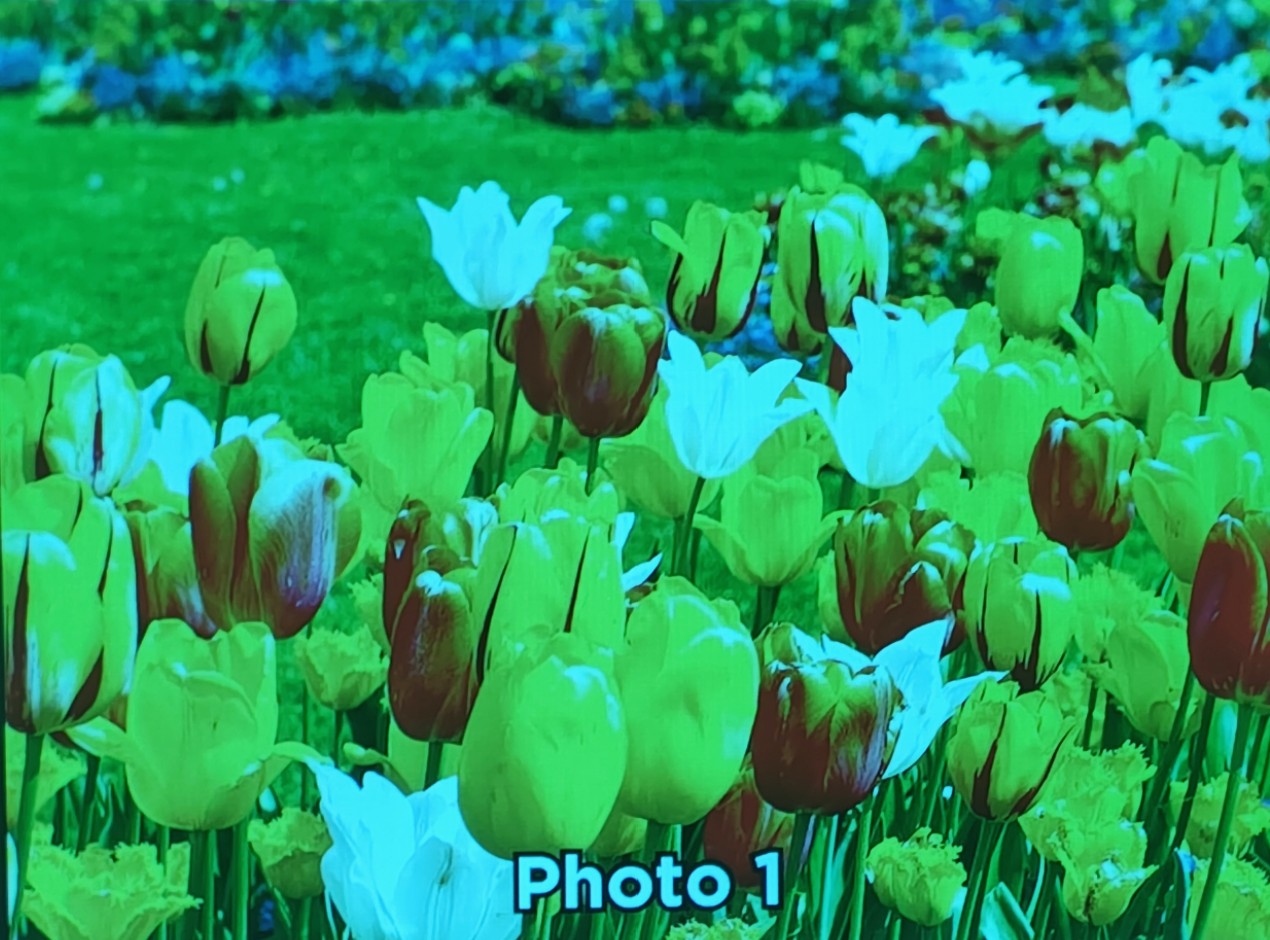
Our measurement tools are designed for TVs – not projector screens. So the tests are more subjective than objective. Even using one of the best smartphone cameras, we cannot accurately show you what was on the screen. In fact, the camera picked up the RGB components of white and the 60 Hz phase.
It is also impossible to accurately measure most parameters as they vary with each mode and screen type.
We conducted a series of tests in Auto Cinema at 20 lumens light and 350 nits at the screen, and 150 lumens light and 150 nits at the screen to ascertain the following. Our results are largely subjective.


Colour accuracy – Pass
The colours are bright and mostly accurate. In Bright mode, it amps the colours at the expense of colour accuracy, but that is what the human eye craves.
Our best estimate on Delta E colour accuracy is about 4 (very good)
This claims 98% Rec. 709 colour gamut, which is similar to sRGB and about 60% DCI-P3 – similar to most 8-bit TVs.


Contrast – Pass
Contrast is the ratio of white to black – how much brighter white is than black. The ratio drops steeply if you don’t have pure black (more of a grey).
It claims 6,000,000:1 Dynamic Contrast, which appears relatively high. That equates to 1,500,000:1 Full-On/Off (FOFO) contrast optics measurement.
Sorry, both of these are marketing measurements. Our estimate is between 1500-2000:1, which is pretty much the same as an LED/LCD IPS TV screen.


Motion Jaggies: Pass
It inserts a black frame (Motion Enhancement) between 24, 25, and 30 fps to smooth motion judder. It does not do this for 50/60Hz content.


Upscale: Passable
It has Advanced Tone Mapping and will upscale 480i/p, 576i/pm 720p, and 1080i/p to 4K.
I suspect it does not upscale so much as use the video input, remembering its four pixels per 1920 x 1080 mirror to get 4K. Tech aside, it was OK for 720 and 1080p – forget old movies.




Gaming: Not tested
BenQ claims it is fine for uopto 4K@60fps gaming. It does not support Dolby Vision games.
CyberShack’s view: The BenQ TK705Sti 4K Short Throw Google TV projector is good in its place
First apologies to BenQ, as the TV tools and apps we use don’t really work well on projectors, particularly those that use RGB LED and DLP 4x pixel projection.
My strongest message is that in a darkened room with a good ALR screen, it will produce acceptable 4K SDR and HDR images. While that screen ideally is between 50-100”, you can stretch that to 150 if it’s very dark.
It is a versatile ‘lifestyle’ projector, making it a convenient all-in-one option for SDR Free to Air and streaming FTA, HDR movies and gaming.
It won’t meet the needs of videophiles and hardcore gamers seeking the absolute best contrast and colour depth of higher-end home theatre. But at the price, nor should that be expected.
Would I buy it?
As a videphile, no. Would my kidults and their children love it – yes. And that is the point. Joe and Jane Average will love this as long as their expectations are met.
BenQ TK705Sti ratings
It is rated as a semi-portable, 4K capable, auto-everything projector with Google TV.
- Features: 85. Fully featured and Google TV as well
- Value: 75. While it is good value for its class, there are TriChroma Laser Cinema PX3 4K Ultra Short Throw Smart Projectors for a few hundred dollars more.
- Performance: 85. It does everything it should as long as it is in a dimly lit room.
- Ease of Use: 85 – Three-year warranty, Google TV and excellent auto-correction
- Design: 85—It’s still a largish silver box, but the gimbal stand makes it stand out.
Pro
Semi-portable with excellent ToF autoscreen correction
Decent sound, but a 3.1 soundbar would materially improve that.
Up to 100″ screen with positive gain in dimmed rooms gives the best image
BenQ is a good company with excellent local support
Con
PWM-sensitive people should look at the image before buying.
3000 lumens won’t defeat a daylight-lit home
Whites have a bluish tint
You need a positive gain screen
An 85″mini-LED TV costs less







Comments